|
|
Home
The 1800'scompiled by Amir Muhammad
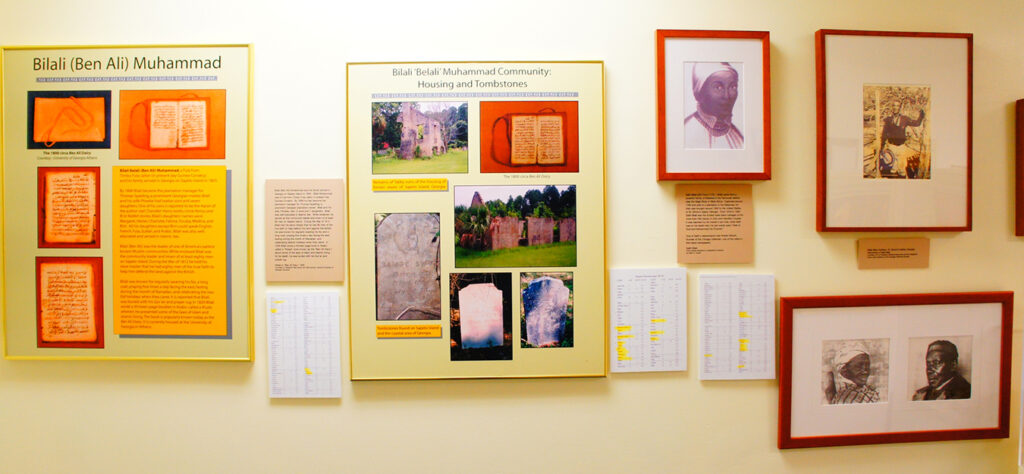
In 1803, Bilali (Ben Ali) Muhammad and his family arrived in Georgia on
Sapelo Island. Bilali Muhammad was a Fula from Timbo Futa-Jallon in
present day Guinea-Conakry. By 1806 he became the plantation manager
for Thomas Spalding, a prominent Georgian master. Bilali and his wife
Phoebe had 12 sons and 7 daughters. One of his sons is reported as
being Aaron of Joel Chandler Harris’ work, author of Uncle Remus and
Br’er Rabbit stories. His daughters" names were Margaret, Hester,
Charlotte, Fatima, Yoruba, Medina, and Bint. All his daughters but Bint
could speak English, French, Fula, Gullah, and Arabic. Bilali was well
educated in Islamic law. While enslaved Bilali became the community
leader and Imam of at least 80 men. During the War of 1812 Bilali told
his slave master that he had 80 men of the true faith to help defend
the land against the British.
Bilali was known for regularly wearing his fez, a long coat, praying
five times a day facing the east, fasting during the month of Ramadan,
and celebrating the two holidays when they came. Bilali was buried with
his Qur’an and prayer rug. In 1829 Bilali wrote a 13 page hand written Arabic text
book called a "Risala"about some of the laws of Islam and Islamic
living. The book is known as Ben Alis"Diary, housed today at the
University of Georgia in Athens.
Bilali "Ben Ali" was the leader of one of America’s earliest known
Muslim communities. It’s documented that in 1812 there were at least
eighty Muslims living on a plantation controlled by Ben Ali from 1806
to the late 1830s.
In 1803, Salih Bilali (Old Tom) came from a powerful family of Massina
in the Temourah district in West Africa. He was captured around 1782,
sold in the Bahamas at first and then in the US around 1803. He lived
from 1770-1846. He was sold to John Couper in the Bahamas and brought
to St. Simon Island, Ga. From 1816-1840 Salih Bilali was the trusted
head slave manager of more than 450 slaves of John and Hamilton Couper.
It was reported by his master’s son, that while Salih was on his death
bed that his last words were "Allah is God and Mohammed his Prophet."
One of Salih’s descendants was Robert Abbott, founder of the "Chicago
Defender, "one of the nation’s first black newspapers. Another one of
Salih’s descendants was named after him Bilali Sullivan who was known
as (Ben Sullivan). Bilali (Ben) Sullivan purchased some of the original property from the plantation in 1914. He was interviewed about his life in the 1930s.
There are two well known Muslim communities of the Gullah Islands of
St. Simon and Sapelo off the coast of Georgia. Bilali (Ben Ali) Mahomet
and Salih Bilali ruled as plantation mangers and Muslim leaders. In
America’s history there were Gullah Wars. Some of them are known as the
Seminole Indians wars. The African-American language Gullah was
initially developed by the enslaved African Muslims and non-Muslims in
Senegal to help communicate among the various African tribes.
In 1805, a slave named Sambo who knew Arabic had escaped from a
plantation on the Ashley River, in South Carolina. The announcement in
the Courier on February 9, 1805 offered a reward of $5 for his
recovery. It stated that he was about 5' 5", slender body and writes
the Arabic language.
In 1807, Yarrow (Mamout) Marmood was given his freedom. Yarrow was
enslaved and brought from Guinea, Africa before the American
Revolution. Yarrow was given his freedom by Upton Beall of Montgomery
County in the Washington, DC area. On April 13, 1807, Upton Beall’s
deed was recorded that the Negro Yarrow was given his freedom because
he was more than forty-five years old and that he would not become a
bother to the County of Washington.
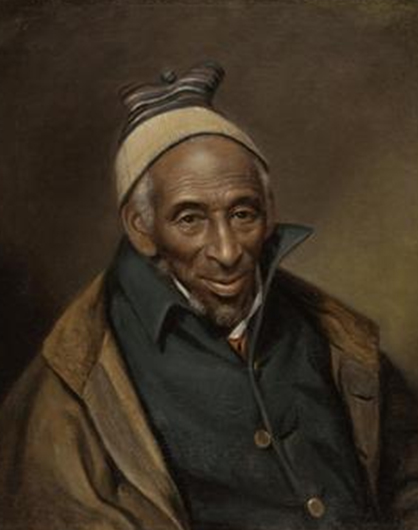
Two pictures of Yarrow
exsits today, one painted by James Simpson in 1822 which hangs in the
Peabody Room at Georgetown public library, and the other picture
painted by Charles Wilson Peale in 1819 which hangs at the Historical
Society of Pennsylvania.
Yarrow Marmood was a property owner in Georgetown in Washington, DC. In
the 1800 and 1810 census Yarrow’s name was listed as Negro Yarrow with
a wife or elderly woman living with him. In the 1810 census Yarrow’s
name was listed as Yarrow Marmood with one woman living with him.
Yarrow had established a hauling business, owned real estate on what is
now 3330-3332 Dent Place NW, and he had invested some of his savings in
the stock of the Bank of Columbia. One of Yarrow’s neighbors and friend
was another manumitted slave named Joseph Moor who became a respectable
grocer in Georgetown.
In Washington, DC the 1820 census identifies Yarrow Marmood and Joseph
Moore, both with families and free men. The census identifies Yarrow
and a female family member and two other free people of color (blacks),
Grace Almonds a family of four and Yarrow’s neighbor Charley Brown a
family of three, and one slave. The 1820 census also has three other
free blacks Obed Diner a family of five, Free Catty a family of three,
and Nelly a family of two.
On April 12, 1844, Yarrow’s estate was administered by probate court in
Washington, DC, under the name Negro Yarrow. Yarrow lived to be more
than 100 years old. The dates of his birth and death have been record
as 1736-1844.
In 1807, Hajj Omar Ibn Sayyid was captured at the age of 37. Omar was a
Fula born in Fur Tur in present day Senegal. He was born from a
Serahule family. Omar lived from 1770-1864. He had studied in Bundu,
Senegal where he learned how to read, write, arabic, Islamic studies,
and made Hajj in Mecca before his capture. Omar was enslaved in
Charleston, SC where he labored for a short period of time before he
escaped in 1810 to Fayetteville, NC where was caught and imprisoned.
While in prison Omar persuaded James Owen, a general in the state
militia and brother of John Owen (who later became Governor of North
Carolina), to purchase him, which he did for $900.00. Omar was also
known as Uncle Moreau.
Omar ibn Sayyid wrote many items in Arabic while enslaved. He wrote the
Lords Prayer, the Bismillah, this is How You Pray, Quranic phases, the
23rd Psalm, and Omar’s latest known writing was in 1857 Surah 110 of
the Holy Qur’an.
Omar was given an Arabic written Bible and a Qur’an by his slave
master. The Bible is housed today at Davidson College in North Carolina.
In The War of 1812, Abraham joined the British Colonial Marines who had
occupied Spanish Pensacola. Abraham lived from 1787-1870. He was well
known as a very gifted individual, soft spoken, and intelligent.
Abraham came to Pensacola, Florida sometime in the early 1800s. During
his years in Pensacola, Abraham had been a slave of Dr. Eugenio Antonio
Sierra, a prominent Spanish physician and surgeon. He was held in high
esteem and worked as an interpreter, for he spoke several different
languages.
Soon after the Fort Negro construction Abraham left out on his own. He
soon gained a reputation as a businessman or a man after profit.
Abraham became involved in trade with the Maroons and the Seminole
Indians of the lower Suwannee River area. Gradually, he was accepted by
the Maroons and became their foremost leader. The Seminoles had a high
regard for Abraham.
Chief Micanopy, the top hereditary chief in the Seminole Nation,
appointed Abraham as the "sense-bearer" or legal counsel. As the
military leader of the Maroons, he was known by the name "Sounoffee
Tustenuggee" which means "Suwannee Warrior." Abraham was married to a
woman named Hagar. Abraham and Hagar had two sons named Renty and
Washington. Abraham lived peacefully with his family and people in the
villa of Pilaklikaha, raising horses, cattle, and growing crops.
After the first Seminole war Abraham and a delegation of Indian Chiefs
went to Oklahoma in 1832 to inspect the land being offered to them in
the treaty that was to move them out of Florida. The United States
officials would not allow Abraham and the others to leave until they
signed the treaty, which they did on March 28, 1833. Abraham opposed
the move, therefore spending almost eight months at Fort Gibson.
Abraham and several other leaders were opposed to the treaty after
learning of its deception, thus the second Seminole war began 1835 to
1842. Abraham had fought in almost every battle of the Seminole Indians
wars until 1837. However, in February of 1839 he moved to Oklahoma with
his family and became a successful cattle rancher.
Abraham returned to Florida in 1852, ten years after the government
officially declared an end to the Seminole war. The government had
hired Abraham to take chief Billy Bowlegs, his father in-law, and some
other chiefs to Washington, DC., in order to convince them to leave
Florida. They met with Millard Fillmore who became President after
Zachary Taylor died. The chiefs still refused to move to Oklahoma. They
went back to Florida and disappeared in the everglades. Abraham went
back to his ranch in Oklahoma where he died years later, sometime after
the Civil War in 1870. He was buried in an unmarked grave in today’s
Seminole county.
In 1818 Medina, Ohio was organized. It was originally called Mecca,
then later it changed to Medina making it the seventh place on the
globe at the time called Medina. Three other cities in America bear the
name Medina- Medina, New York; Medina, Michigan and Medina, TX.
In 1828, Abrahim Abdul Rahman ibn Sori (1762-1829) was set free by the
order of the Secretary of State Henry Clay and President John Quincy
Adams. He was born in Timbo, West Africa (in present day Guinea). He
was known as the "Prince of Slaves." He was a Fulbe from the land of
Futa Jallon. Abrahim left Futa in 1774 to study in Mali at Timbuktu.
Abrahim was captured by warring tribes and sold to slave traders in
1788 at the age of 26. He was bought by a Natchez, Mississippi cotton
and tobacco farmer, where he eventually became the overseer of the
plantation of Thomas Foster. In 1794 he married Isabella, another slave
of Foster’s, and eventually fathered a large family. In 1826 he wrote a
letter to his relatives in Africa. A local newspaperman sent a copy to
Senator Thomas Reed in Washington, who forwarded it to the U.S.
Consulate in Morocco. After the Sultan of Morocco read the letter, he
asked President Adams and Secretary of State Henry Clay to release
Abrahim Abdul Rahman.
In 1807, a coincidental meeting took place. John Cox, an Irish ship’s
surgeon, whose life had been saved by Abrahim’s father many years
earlier. John Cox recognized the Prince in the market, learned of his
story, and began petitioning for his freedom. Twenty five years later
in 1828 at the age of 66 Abrahim gained his freedom. Rahman had been a
slave in America for forty years before he got his freedom. Rahman and
his wife sailed for Africa in February 1829. The following September
his former owner died. Foster’s heirs sold two of Rahman’s children and
five of his grandchildren to the American Colonization Society (A.C.S),
and they were reunited with his wife in Liberia.
In 1828, a Muslim named Sterling living in Hartford, CT met Abdul Rahman during his visit to the New England States.
In 1832, The Village of Mahomet, IL was laid out. Mahomet, IL was
originally named Middletown. Sometime during the 1840s it was changed
to Mahomet, IL.
In 1834, A Muslim woman named Sylvia appears in "Knights of the Golden Horseshoe,"by William A. Carruthers.
In 1834, in Tennessee, a Muslim by the name of Hamet Abdul is reported to have sought money to return to Africa.
In 1834, two Muslims by the names of Jupiter (Dawud) Dowda and Big Jack
were reported by the American Colonization Society’s "The African
Repository"to be well-known slaves in New Orleans. Big Jack was a
plantation manager.
In 1835, Lamen Kebe known as (Old Paul) was liberated after having been
in servitude in South Carolina and Alabama. Lamen Kebe was captured in
battle and arrived in America in the early 1800s. He was from an elite
class of Serahule who were trained to rule, advise, teach, protect,
trade, translate, collect taxes, and travel. His family were the
founders of ancient Ghana, and they were among the earliest converts to
Islam south of the Sahara. His mother was a Mandinga. In Senegambia, he
was a schoolmaster in the land of the Fulah before his capture. Lamen
and Omar Sayyid corresponded with each other in 1835 in Arabic. Lamen
(Old Paul) through Omar, provided Theodore Dwight, a member of the
American Ethnological Society, with information of his native land and
school system. Lamen returned back to Africa at the age of sixty in
1835.
In 1839, Oman’s ruler, Sayyid Sa’id, ordered his ship "The Sultana"to
set sail for America on a trade mission. The ship touched port in New
York on April 30, 1840. The voyage was not a commercial success. The
ship’s commander, Ahmed bin Nauman bin Muhsin Al-k’abi Al-Bahraini came
from Zanzibar. Ahmed bin Nauman bin Muhsin Al-k’abi Al-Bahraini’s photo hangs today on the third floor of City Hall in New York, NY.
In 1845, Osman Rockman died. His tombstone was found in Connecticut.
In 1852, Osman known as "General Osman" became the leader of the North
Carolina Dismal Swamp community from 1852-1862. Osman was a runaway
slave from Virginia and lived in the dismal swamp. At one time the
dismal swamp was partly owned by George Washington, the first President
of the United States. The swamp was drudged out by slave labor in the
mid 1700s.
In 1856, The United States cavalry hired a Muslim by the name of Hajj
Ali to experiment with raising camels in Arizona. He experimented with
breeding camels in the desert. He became a local folk hero in
Quartzsite, AZ, where he died in 1903. He was known as "Hi Jolly", his
tombstone is a stone built pyramid with a camel on top of it.
In 1859, in Savannah, Ga, many slaves were sold from the Butler
plantation in Darien, Ga. Some of the slaves sold were Muslims. It was
reported that some of the women wore gorgeous turbans and one of them
had a string of beads. At the auction a Muslim named Abel age 19 was
sold for $1,295, and one named Hagar, age 50, was sold for $300.
In 1860, a Muslim lady known as "Old Lizzy Gray" died in Edge field
County. Her obituary, appeared on the front page of the Edgefield
Advertiser, on September 12, 1860. Her physician and owner Dr. E.J.
Mims wrote that according to the best computations she was 127 years of
age. She had four children in Africa before being taken prisoner.
During the revolution she was a prisoner on board an English ship.
Before her capture she was educated as a Muslim. As a slave she seems
to have combined both faiths and became a member of the Methodist
Church. She was known to have always said "Christ built the first
Church in Mecca."
In 1860, Muhammad Ali ibn Said (1833 - 1882), known as (Nicholas Said)
arrived in America as a free man. Muhammad was born in the Kingdom of
Bornoo, West Africa near Lake Chad to a well-educated merchant family.
Said was kidnaped and enslaved when he was 16. His first slave master
was an Arab named Abdel Kader who took him to Tripoli and Fezzan.
Muhammad was then sold to Alexander Menshikov, an aide to the Russian
Czar, then to Nicholas Trubetzkoy with whom he traveled to many places
during his years of slavery from Russia, Rome, Persia to France. In
1860 he left Liverpool, England with a man from Holland to travel to
Boston, New York, Kingston, New Providence, Toronto, Quebec, and other
places in North America as a freed man.
In 1861 he arrived in Detroit. Shortly afterward he found a teaching
job and in 1863 Muhammad enlisted in the 55th Massachusetts colored
regiment and became a Civil War hero. He served faithfully and bravely
with his regiment as Corporal and then Sergeant in the South. Near the
close of the war he was assigned, at his own request, to the hospital
department, to learn some knowledge of medicine. His Army records show
that he died in Brownsville, Tennessee in 1882.
In 1864, a monument was erected in New England for a Mr. Smith and it
is crowned with three slain Muslim’s heads who were slain by Mr. Smith. From the Isles of Shoals.
In 1864, Captain Harry Dean was born. He was the son of Susan Cuffe
Dean whose brother was Paul Cuffe. Captain Dean’s family came from
Quata, Morocco. For three generations the family were wealthy merchants
in Philadelphia. Captain Dean found the first black nautical training
school in America. Dean maintained his family’s Islamic tradition
during his seafaring days on the ship "Pedro Gorino" and in southern
Africa where he tried to build an African empire. He was also
associated with the Muslim Mosque of London. In the United States he
distributed Islamic literature in Chicago, Los Angeles, Seattle, and
Washington state.
In 1866, The Cherokee chief had a Muslim name, Chief Ramadan ibn Wati.
Muslims were known to live among many of the different Indian tribes.
They lived among the Seminole Indians, The Delawares, The Nanticokes,
The Cherokees, and many others.
In 1869, a number of Muslims from Yemen arrived in the United States
after the opening of the Suez Canal. Most Yemenis came through New York
to Buffalo, and Detroit. Many Yemenis jumped shipped in San Francisco
and settled on the West Coast.
In 1875, The first small wave of Muslim immigrants arrived, mainly from
Greater Syria (Syria, Lebanon, and Palestine). Some of the
Syrian-Lebanese Arabs settled on Manhattan’s lower Washington Street
and in Brooklyn across the East River around Atlantic Avenue and South
Brooklyn. A smaller number came from the Punjab area of India.
In 1876, The Centennial Exposition in Philadelphia, attracted Arab
merchants and peddlers, where they sold an assortment of merchandise,
and some set up centers to import goods.
In 1877, Seven Algerian escapees from French Guyana were admitted by the Mayor of Wilmington, Delaware, and held as exiles.
In 1884, Sambo Swift died. He was born in 1811, and lived in Darien, GA. He was buried with his tombstone
facing northeast. Engraved on his tombstone is a hand pointing with one
finger up as the Islamic symbol of God’s oneness. This symbol was used
by Muslims dating back more than 1400 years. It is believed that Sambo
was one of the slaves left on the Butler plantation at the time of the
great slave sale of 1859 in Georgia. Sambo was a carpenter and had at
least three children named Abraham, Mollie, and Alonzo.
In 1889, Edward Wilmot Blyden, a noted scholar and activist, traveled
throughout the eastern and southern parts of the United States
proclaiming the truth of Islam. Edward Wilmot Blyden (1832 - 1912) was
born in St. Thomas, Virgin Islands on August 3rd, 1832. In 1850 he
emigrates to Liberia from America and by 1855-56 became the editor of
the Liberian Herald. Blyden served for three terms (1864-1871) as
Secretary of State of Liberia, and on three postings as Ambassador to
the Court of St. James in 1877, 1879, and 1892-94.
In 1858 Blyden was ordained as a Presbyterian clergyman. By 1886 he
resigns from the Presbyterian Church and becomes a Muslim, one of the
first known freed Africans to revert back to Islam. In 1887 Blyden
published his first book Christianity, Islam and the Negro Race.
From 1901-1906 Edward Blyden was the Director of Mohammed Education in Sierra Leone.
In 1893, Mohammed Alexander Russell Webb
(1846-1916) appeared at the First World Exposition Conference on World
Religions in Chicago, where he delivered two lectures, "The Spirit of
Islam" and "The Influence of Islam on Social Conditions." Among the
audience was Mark Twain. Webb converted to Islam in 1888 while he was
serving as the American Consul to the Philippines. He was also a
Journalist. Webb is known as the first white American convert to Islam.
In 1893, Mohammed found the first Islamic organization in America
called "The American Moslem Brotherhood" in New York.
In 1897, The Federal government allotted free land, consequently
Syrians started moving to Rugby and Williston, North Dakota. From
1899-1914 a total of 86,111 Syrians arrived in America.
In 1897, Elijah Muhammad (1897-1975) is born in Sandersville, Georgia.
He became the leader of The Nation of Islam from 1934 to 1975.
In 1899, Hassen Juma had settled in Ross, North Dakota with 160 acres
of free land. By 1902 twenty families had followed his path from Birey,
Syria. In the early 1920s they built one of the Nations first Mosque.
In the late 1800s many people and former slaves used the Islamic symbol of God’s oneness on their tombstones.
|
|